27/07/23
PRESS RELEASE
DANIELS G.O

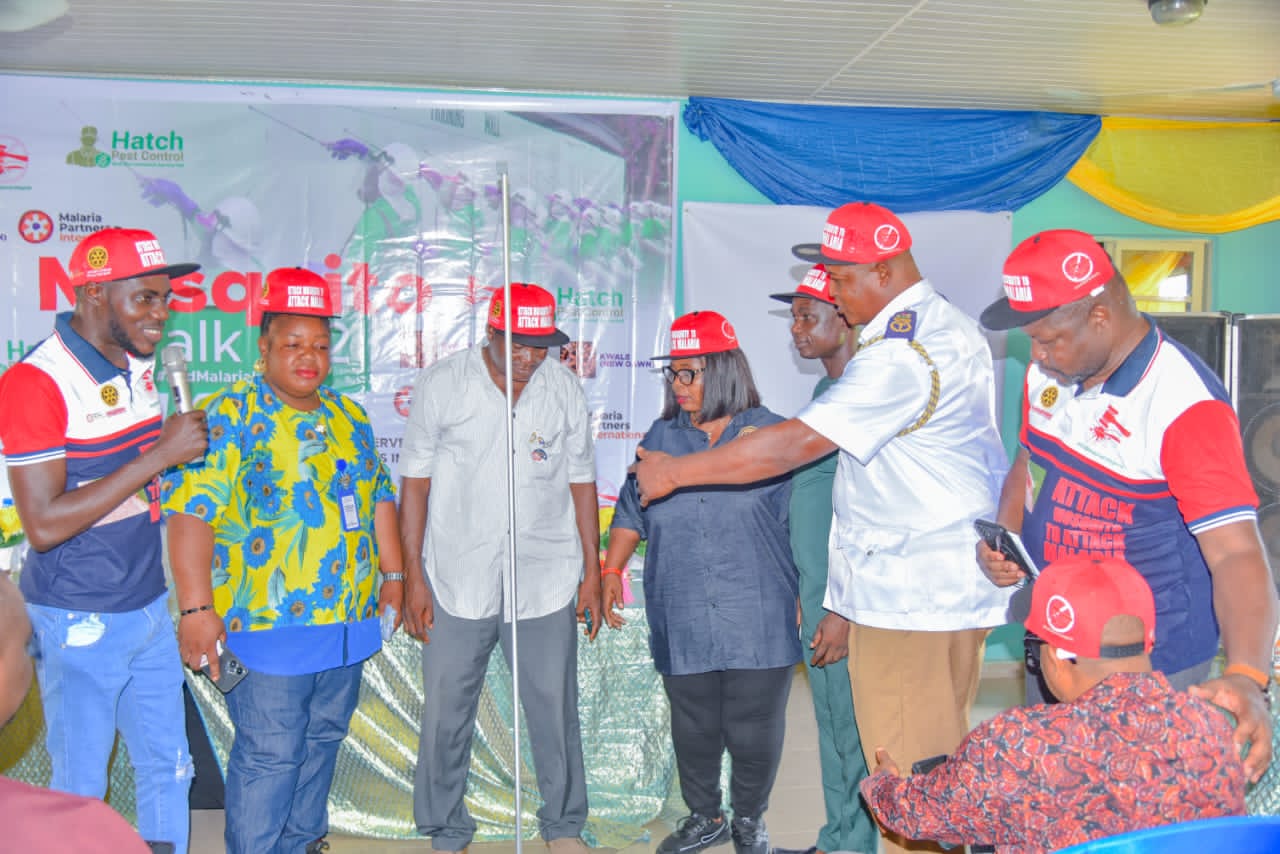
THE UNVEILING OF MOSQUITO CONTROL INTERVENTION AMONG 300 PREGNANT AND NURSING WOMEN IN NDOKWA WEST LGA, KWALE, DELTA DONE BY EndMalariaInNigeria, Malaria Partnersinternational (MPI), Rotary Club of Kwale (New Dawn), Hatch Pest Control and Environmental Service Ltd
The event had 106 Persons in attendance, Among are Dignitaries which includes: Supervisor for Health; Ndokwa West Local Government, Mrs. Joyce Okonye, NULGE Chairman (Comrade Ikechukwu Opone) Rotary President (Kwale New Dawn) Alexander Osademe) and immediate past President Juliet Onakpovhie, Representative of EHCON Sanitarian Clement Okonye, and the team of Hatch Pest Control and Environmental Service Ltd,
THEME: ATTACK MOSQUITO TO ATTACK MALARIA!
26/07/23.
HISTORICAL BACKGROUND
In the aftermath of the discovery by Dr. Ronald Ross in 1880, that Mosquito is the vector that transmit Malaria most malaria intervention programs were more of preventive.
CONSTRUCTION OF THE PANAMA CANAL
The discovery by Major Ronald Ross that malaria was transmitted by mosquito had tremendous impact on development programs in the tropics. One of the first of these was the construction of the Panama Canal, which began within a few years after Dr. Ross’s discovery.
One of the biggest obstacles for the workforce was sickness. Malaria and yellow fever, spread by mosquito bites, killed more than 22,000 workers before 1889.
An integrated program of mosquito control was initiated that involved seven basic programs that were strictly enforced. These were, in order of importance:
Drainage: All pools within 200 yards of all villages and 100 yards of all individual houses were drained.
Brush and grass cutting: All brush and grass was cut and maintained at less than one foot high within 200 yards of villages and 100 yards of individual houses. The rationale was that mosquitoes would not cross open areas over 100 yards.
Larviciding: Larvaciding was done. At the time, there were no commercial insecticides.
Prophylactic quinine: Quinine was provided freely to all workers along the construction line at 21 dispensaries. In addition, quinine dispensers were on all hotel and mess tables. On average, half of the work force took a prophylactic dose of quinine each day.
Screening: Following the great success in Havana, all governmental buildings and quarters were screened against mosquitoes.
Killing adult mosquitoes: Because the mosquitoes usually stayed in the tent or the house after feeding, collectors were hired to gather the adult mosquitoes that remained in the houses during the daytime. This proved to be very effective.
NIGERIA MALARIA CHALLENGES
Malaria is a tropical acute and chronic life-threatening parasitic protozoan disease characterized by fever. It is transmitted from one person to another through the bite of infected female Anopheles mosquitos which is its known vector; and it transmits a protozoon of the Plasmodium genus. The most common specie in Sub-Sharan Africa is P.falciparum, causing over 300, 000 deaths per annum in Nigeria alone accounting for 31.6% percent of the Global malaria mortality rate.
Mosquito breed in a dirty environment such as stagnant water, improper disposed waste, improper drainage systems, leaving overgrown grasses in our surroundings.
NIGERIA ENVIRONMENTAL CHANGES
a. POOR DRAINAGE AND SEWER SYSTEM
Nigeria gutters and Sewer System have been constructed in such a way that liquid waste has no central collection point it drains into, rather the liquid has become a consistent breeding source for mosquitoes.
As been established above that mosquito developmental process is on water. This means that if the current Government both at Federal and States can mobilize Environmental Health Professionals with the task to genuinely come up with blueprint to alter certain environmental factors that will truncate the metamorphosis of mosquito, Nigeria would be able to have an official document that guide malaria elimination interventions and a possible projected date to eliminate Malaria in Nigeria.
b. POOR WASTE MANAGEMENT
Poor solid waste management, where in the 21st century Nigeria still practice open dumping has to be discouraged. Most of the waste articles serve as receptor of water where mosquito can lay eggs and develop into adult. Government need to consider building Sanitary landfill in every State of Nigeria for proper management of solid waste and jettison open dumping practice. Government should Implement a PAY-TO-DISPOSE RUBBISH POLICY in Nigeria, Build Sanitary Landfill to control Mosquito breeding spaces.
GOVERNMENT AND NON GOVERNMENTAL MALARIA INTERVENTION SO FAR.
EndMalariaInNigeria commend efforts and interventions being made by various groups, individuals and Government agencies Over the years towards malaria elimination in Nigeria and it is in recognition of this that we have in the last one year advocated a redirection in the methods of intervention from curative to preventive.
Although, the use of IPT, prophylaxis and distribution of ITNs to pregnant women has helped in reducing malaria mortality among pregnant women in some regions of the country when compared to previous records, however certain factors has limited the effectiveness of this methods. Most rural Nigeria women due to lack of education are still attached to some cultural and religious beliefs that dissuade them from taking this treatments.
Also, the poor housing system with no ventilation compounded with epileptic power supply is a discouraging factor for not using distributed insecticide treated nets (ITNs)
UNDERFUNDED MALARIA VACCINE DEVELOPMENT LABORATORY AND NIGERIA INSTITUTE OF MEDICAL RESEARCH
Recently, Nigeria and Ghana approved the R21/Matrix-M malaria vaccine produced by Oxford University which is an improved version of the RTS,S vaccine that has already been approved by the WHO.
It is worrisome that the Nigeria Vaccine Development Laboratory that was active for about six decades, between 1940 and 1991, producing large quantities of vaccines against smallpox, rabies, yellow fever for not only Nigeria, but neighbouring countries like Cameroon, Central Africa and a few other countries in Africa has remain dormant. Though It was closed in 1991 by the federal government which said it wanted to reactivate and upgrade the facility, its resuscitation has remain a mirage. A once viable Laboratory has been abandoned to donor funding.
Similarly, the Nigeria Institute of Medical Research (NIMR) established under the enabling Act of 1977 which focuses on scientific area of research in Biochemistry and Nutrition, Virology Vaccinology, Immunology, Health system and policy research, Reproductive, Maternal and Childhood diseases Research, Clinical Science, Microbiology, Molecular biology Biotechnology and public Health, with studies that focus on diseases has also remain underfunded by government and left to donor funding.
NIGERIA MALARIA ELIMINATION COUNCIL
I call on the Aliko Dangote led Nigeria Malaria Elimination Council, to join #EndMalariaInNigeria in the promotion of Malaria preventive approach rather than curative, and learn lessons from similar failed efforts like the Role Back Malaria program in 1998, initiated and funded by international organizations like WHO, UNDP, USAID, World Bank, UNICEF, and up till now Malaria has remain the heights killer disease in Nigeria 20 years after the intervention. If such intervention had been focused on reconstruction of drainages, proper waste management, indoor residual spraying of homes, resuscitation of Primary Health care, establishing more research and vaccine production centers, Nigeria would have been on the road to malaria elimination.
We use this occasion of Mosquito talk 0.2, to call on government, Federal, State and Local, to immediately mobilize Environmental health professionals in coming up with National environmental health and water management plan that will address drainage and Dams construction, construction of sanitary landfill etc as a direct process of fighting mosquito in Nigeria.
Government should also invest in primary health care and improve remuneration for health workers, adequately fund Nigeria vaccine development laboratory, Nigeria Institute of medical research. We also call on government to establish and adequately fund research centres in Universities across the nation.
We use the occasion to call on Federal, States, Local government as well as international organizations to renew commitment and efforts in ending malaria in Nigeria through partnership with organizations like the #EndMalariaInNigeria in combating Mosquito in Nigeria.
NIGERIA CAN ATTAIN A MALARIA FREE STATUS.
A country is granted malaria-free certification by WHO when the country proves that it has interrupted indigenous transmission of the disease for at least 3 consecutive years.
If African countries like Lesotho, mauritius, Algeria Libya, Egypt, LA Reunion, Seychelles, Tunisia have been declared malaria free, then Nigeria can put an end to the over 200, 000 deaths caused by malaria. Just this year 2023, Tajikistan, Azerbaijan and Belize have been declared Malaria by the World Health Organization.
Francis Nwapa Watch
Convener: #EndMalariaInNigeria
 Dara Network TV